How Kameleoon rebuilt its design system and gained autonomy by migrating to Webflow
Kameleoon sought to move away from Drupal to a CMS that would give its marketing team more agility and autonomy over its site. With KLIMB, the team rebuilt its design system from scratch and migrated several hundred articles, gaining true daily autonomy in publishing new pages.
SECTOR
Web Experimentation Platform
LAUNCH DATE
September 2025
DURATION
2 months
KLIMB TEAM
Strategy, Development
One year later
What we remember
Based on the testimony of the Kameleoon team, one year after the launch.
Data provided by Kameleoon
Several hundred
articles migrated without breaking SEO
1 month
to implement hundreds of pages
Trained in Webflow
to adjust the site without needing a developer for every detail
Part 01 · Context setting
Can you introduce yourself, present Kameleoon, and tell us what prompted you to migrate to Webflow?
I am Seimour Darbandi, I have been working at Kameleoon as a Senior Brand Designer for 2 years now. Kameleoon is an AI optimization platform that allows marketing and product teams to conduct A/B testing, real-time personalization, and feature management on their websites and applications. We are about 300 people, spread across France, Germany, the UK, Spain, and North America.
When I joined Kameleoon, the team was already on Drupal, with the old brand, but I never set foot on it. The team really wanted to change. I recommended Webflow for several reasons: I knew that other companies of our size were using it, and the fact that KLIMB works on Webflow also mattered a lot. We also had the option of a headless CMS, but it was much less convenient for us on the marketing side, since we are the ones managing the site.
Part 02 · A design system to rebuild
How has Webflow changed your daily design workflow?
I didn't really have a web design workflow before Webflow, because everything happening on Drupal wasn't my area, plus it was the old brand, so I wasn't particularly interested. But the speed with which we built this new site was greatly facilitated by Webflow.
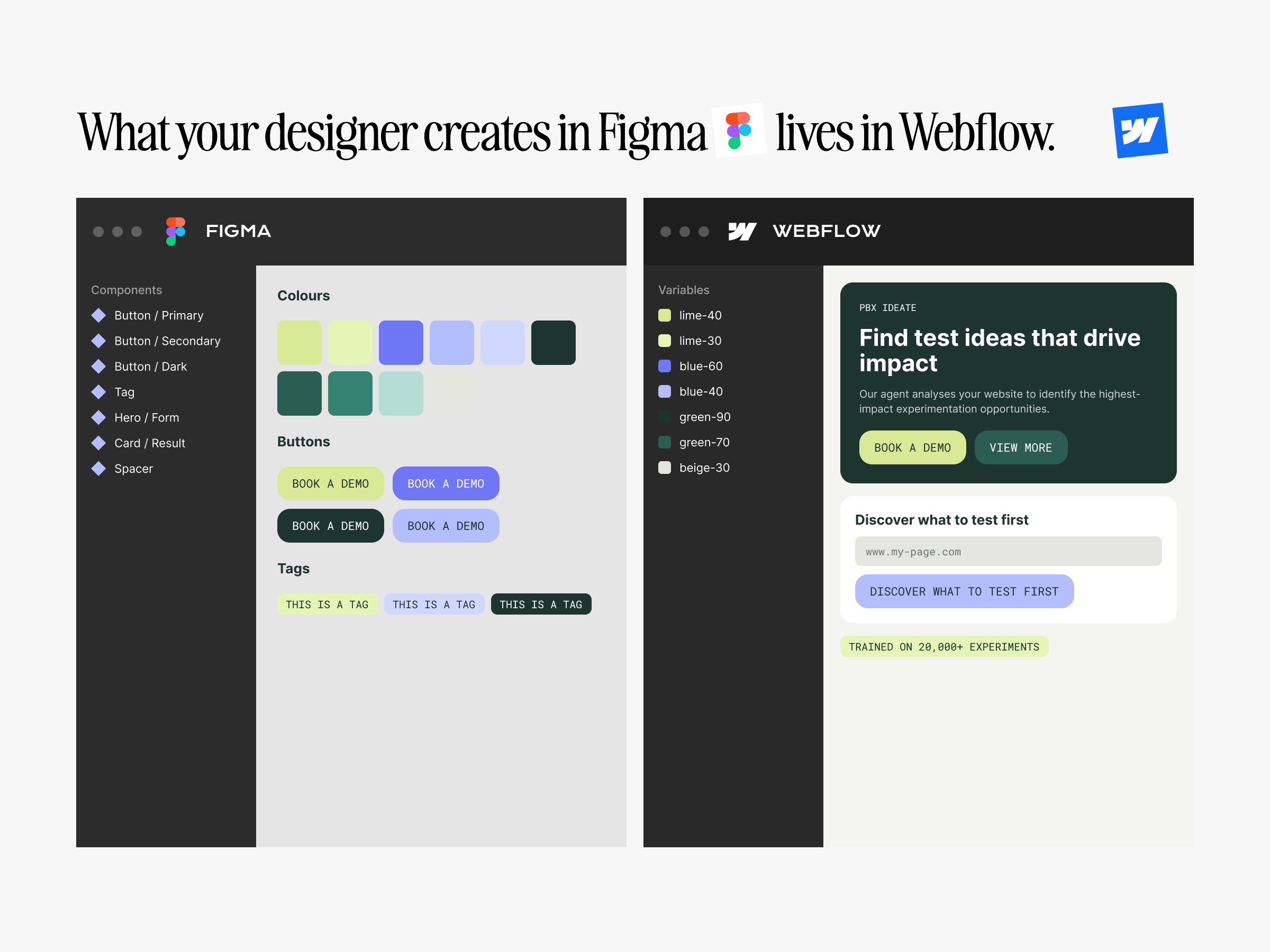
The component aspect, variables, and structure that Webflow offers allow for real agility in page construction. We were able to rebuild the design system from scratch, starting from Figma, and once it was built, it was quite quick. Today, we have a lot of agility to create new pages.
On the content side, the transition of all our articles to the CMS was a success: we had several hundred articles to migrate, and it was done on time.
"The biggest victory is a beautiful, clean site, with a new brand in record time, which is now functional, on a solid foundation that we can now push to the next level."
Part 03 · Maintaining consistency among many
How do you maintain design consistency when multiple people are working on the site?
It's a bit of a puzzle, but in our team we have good communication, and a demanding marketing director with a good design eye. I made sure to get involved in all the page validation processes to say: it's me, I'm here, I validate the design, which was very well received. That doesn't prevent teams from sometimes needing independence and speed, so there are times when small inconsistencies arise. But overall we manage well: Magali, our marketing director, has a very sharp eye and immediately sends it back to me if something is wrong.
Anthony (integrator at KLIMB) is very available to help us correct things. I also trained in Webflow to be able to modify things without bothering him for every detail, and I connected Claude to Webflow to help me identify how to fix certain issues.
Part 04 · One year later
Since you switched to Webflow, what has been the biggest design victory?
It's hard to say, because I wasn't using Drupal before. But the biggest victory is a beautiful, clean site, with a new brand in record time, which is now functional. We can now evolve it to the next level. It allowed us to have a very solid foundation in record time.
Webflow expert note
"What really allowed us to move quickly on this project was building the design system once, properly, before starting to roll out the pages. Once this foundation was laid in Webflow (components, variables, structure), rebuilding and evolving the site becomes a matter of assembly rather than starting from scratch each time. This also allows the Kameleoon team to maintain control over the site on a daily basis, without relying on a developer for every change."

Anthony PETREMANT
Webflow Engineer, KLIMB
Part 05 · The KLIMB support
How was the support from KLIMB throughout the project?
It was great, honestly, it was smooth, it went really well. The collaboration with Lénaïc was really good, because she helped us structure and move forward at a good pace to succeed in shipping on time. She was demanding, and that's also what we expect from an agency: not just to endure, but to be an active participant in the project and bring additional expertise. We also worked with Sajid on the dev side, who was super nice, with great communication, he took my feedback without issue, he was diligent. We had to move quickly, and there were times when many things took time to finalize, even after the launch. But overall, everyone at KLIMB was always willing to continue working to reach the level of quality we wanted.
Later, with Anthony, we worked on the homepage, I was even more demanding than on the entire site, and he followed through: he even seemed happy to work at this level of demand. It never blocked anywhere.
Part 06 · What made the difference
In hindsight, what weighed most in the success of this project from a design perspective?
I think it's the organization and the vision: you need a good vision of how the site will be built to effectively mock up and create reusable components and sections. We really put effort into minimizing and reusing our components as much as possible to make it efficient and easy to implement. It's this organization in creating assets and their reuse that allowed us to ship at record speed.
Webflow allows for real creative freedom while staying within a well-coded and well-constructed system. It's quite a technical product that enables the construction of demanding things while maintaining a coherent design system. I think it fits well with companies like ours that need agility and flexibility in publishing.
Are you preparing the same migration?
We start with an audit of your current site: URLs, content, design system, and performance. You will leave with a plan, even if you don’t work with us.