
How Delville Management Increased Organic Traffic by 50% by Migrating to Webflow
Delville Management sought to rethink its WordPress site without losing its SEO during a rebranding with KLIMB. By having its SEO agency and KLIMB work together from the start, the company saw its organic traffic increase by 50% and its business opportunities double since the migration.

SECTOR
Interim Management
LAUNCH DATE
May 2026
DURATION
1 month
KLIMB TEAM
Design, CMS Migration
6 months later
Key Takeaways
Based on Clarisse Maître's testimony, 6 months after the launch
Data provided by Delville Management
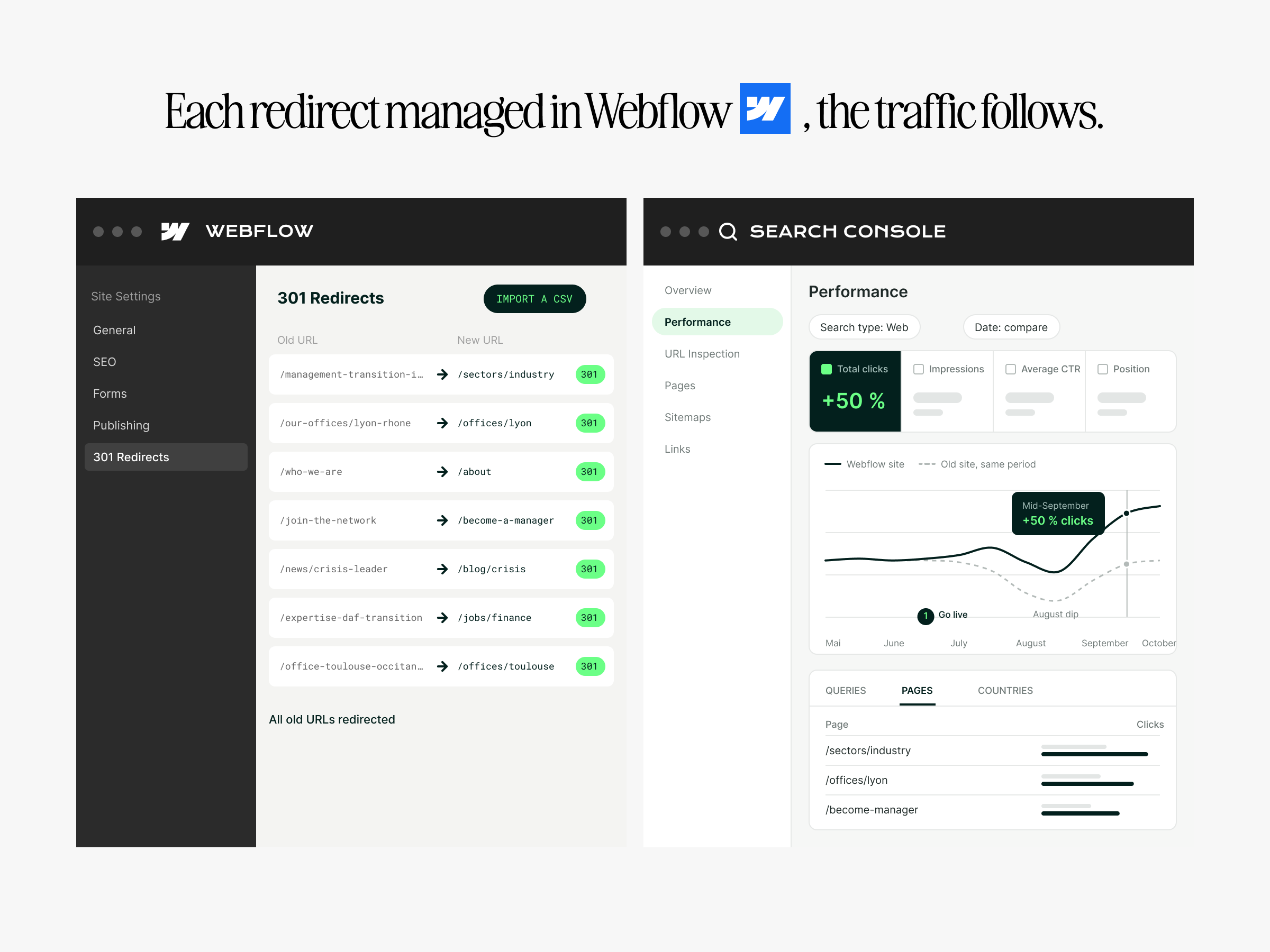
+50%
of organic clicks between mid-July and mid-September, compared to the old site during the same period
×2
monthly business opportunities from Google since the migration
Organic Traffic
stable from the first month after the launch
Part 01 · Setting the Scene
Can you introduce yourself, present Delville Management, and tell us what prompted you to migrate to Webflow?
I am Clarisse Maître, Marketing and Communication Project Manager at Delville Management, and SEO and GEO are part of my scope. Delville Management is one of the pioneers of interim management in France. We support companies that need a leader or operational executive quickly, with a shortlist of profiles presented within 72 hours. Our difference lies in a triple expertise: sectoral, with practice directors who have themselves led in our clients' sectors; local, thanks to our offices in the regions and internationally; and functional, with sourcing teams specialized by function. In over 15 years, we have completed more than 1,500 assignments.
We are about sixty people, with six offices in France (Paris, Lyon, Lille, Nantes, Toulouse, Strasbourg) and a presence in the UK, Germany, Italy, Spain, and Morocco.
Before the migration, we were on WordPress. The trigger for this migration was the rebranding carried out with KLIMB: we had to rebuild the site anyway. We took the opportunity to review all our strategic pages, which had become too long and not user-friendly. The goal was to improve user experience and conversion rates without sacrificing SEO, and it was precisely this balance that needed to be mastered.
Part 02 · Laying the Groundwork
What SEO precautions did you take before launching the migration?
First, we chose our SEO agency before the migration, not after, so that they could work directly with KLIMB on redirects, tags, and internal linking.
At the same time, we measured the existing situation before modifying it: from April, all our priority pages were recorded in our tracking tool, with their keywords and positions, to compare after the switch.
We then rewrote our strategic pages following their SEO score. When a shorter text was more readable, we accepted that this score might drop a bit. On the day of the launch, our tracking table was ready.
Part 03 · What Really Happened
What actually happened to your positioning and traffic in the weeks following the launch?
In the first month, almost nothing happened, and that was the best possible scenario: clicks from Google remained at the level prior to the switch. By the end of July, traffic had dropped significantly. At the time, it was concerning. But comparing with the previous summer, we saw that the site loses about 40% of its clicks in August each year: that's the seasonality of B2B, not the migration.
Over the year, the outcome is positive: between mid-July and mid-September, the Webflow site generated nearly 50% more clicks than the old site during the same period, and the gap has been maintained since the start of the school year.
"The most important thing was to interpret the numbers correctly: compare each period to the same period of the previous year to eliminate seasonality, and be wary of peaks that are too good to be true. Two of them actually came from bots. That's why Search Console became our reference: it measures what users actually do."
Part 04 · What Mattered Most
What technical SEO elements mattered most?
Redirects, without a doubt. A migration is primarily a change of address for each page: if an old URL does not redirect to the correct new page, everything it had acquired in Google is lost. We associated each old page with its new version, and continued to do so after the switch whenever we deleted or merged content.
Next, the structure: moving from a site where content had accumulated over the years to a clear architecture, by profession, sector, and office, helps both Google and visitors.
Finally, metadata became the simplest point: on Webflow, the title and meta description are part of each page's fields. You can no longer forget them when creating a page.
Webflow Expert Note
"What Clarisse describes corresponds to what we see in every migration: redirects are the real technical turning point. Webflow makes this part easier: you can import the entire redirect plan at once via a CSV file, rather than creating them one by one by hand, which significantly reduces the risk of forgetting any. The native SEO fields per page (title, meta description) also help the team remain autonomous on this point once the site is live, without relying on a developer for every update."

Anthony PETREMANT
Webflow Engineer, KLIMB
Part 05 · KLIMB's Support
How did the support from the KLIMB team go throughout the project?
In a migration, the risk is that design and SEO progress separately. So I had KLIMB and our SEO agency work together from the start. On my side, I rewrote the content and made decisions between UX and SEO, the SEO agency validated the technical part, and KLIMB integrated everything into the new site. This three-way collaboration worked very well, especially because KLIMB played along.
Another strong point is continuity. The team did not stop at the launch: they remained available and accommodating for new pages and our brand materials. And project management was solid from start to finish, which matters a lot on a project of this size.
Part 06 · Clarisse's Advice
In hindsight, what would you do differently, and what advice would you give to a team about to undergo a migration?
I would choose reliable indicators from the start. During the migration, we followed positions in third-party tools a lot. Along the way, this data became less reliable, and part of the traffic was inflated by bots. Today, we rely on Search Console and conversions, and I wish I had started from there.
Conduct a complete inventory of your site before the switch: each URL, what it brings in traffic and requests, and the address to which it will be redirected. Once the old site is turned off, it's too late to check what existed. This file is your safety net.
Do I recommend Webflow and KLIMB? Yes, with a nuance: Webflow does not do SEO for you, but it gives you control: redirects, tags, new landing pages, everything is managed directly, without relying on a developer. As for KLIMB, I recommend it because the team thinks about the site in the long term. A site continues to be built long after it goes live, and KLIMB remains a true partner during this phase.
Are you preparing the same migration?
We start with an audit of your current site: URLs, content, design system, and performance. You will leave with a plan, even if you don’t work with us.